
 Photo: Jan Persson.
What is required for DRT services to be geographically accessible, efficient and sustainable in the long term?
Much of the research on DRT is based on simulations and models. But what can we learn from services that have actually been implemented in practice? A new report examines experiences from 28 different DRT services. One of the most important conclusions is that services should be based on local conditions in order to succeed in the long term.
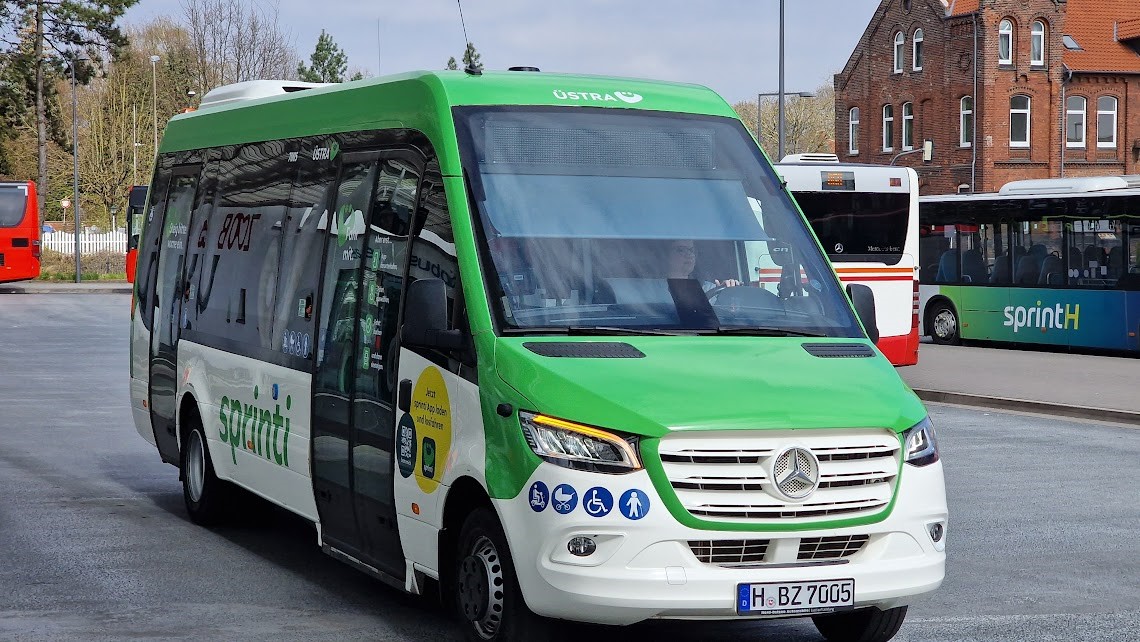
In the project, the researchers have examined 28 demand-responsive public transport services, DRT, which were considered particularly relevant to study from a learning perspective. These include both ongoing and discontinued services, primarily in Europe but also in other parts of the world. What they all have in common is that passengers should be able to request to travel now/as soon as possible and that there is an ambition for journeys to be shared.
“We wanted to find out what practical lessons can be learned from DRT services that have actually been implemented. What types of service design seem to work, for which target groups and under what local conditions? We also wanted to understand what has not worked and how integration with other public transport, as well as booking, waiting times, vehicle choice and pricing, affect use and the prospects for long-term operation,” says Jan Persson, a researcher at MAU and K2 who leads K2’s Policy Lab for Demand-Responsive Public Transport, in which research assistant Minja Odai carried out the current study.
Fundamentally, it is about understanding how more flexible public transport can contribute to better geographical accessibility where conventional scheduled services are insufficient, for example in rural areas or during the first and last part of a journey, and how accessible and inclusive mobility can be provided with a reasonable use of resources.
One model does not fit all
One of the most important conclusions is that there is no universal DRT solution that works for everyone.
“The service needs to be based on a clearly identified local need and planned together with conventional public transport, so that it complements rather than competes with it. Integrated journey planning, booking and payment can make the journey easier. Predictable waiting times and clear information are key factors, as is the option of booking by phone for those who need it. Vehicles and fares need to be adapted to demand. At the same time, low occupancy, high costs and dependence on subsidies are recurring challenges,” says Jan Persson.
The intention is that the results can be used as a basis for planning and discussion by public transport authorities, municipalities and operators wishing to introduce or develop DRT. The conclusions can provide support in formulating clear objectives, choosing service models and booking solutions, and assessing how a DRT service should interact with buses and trains.
“Another important implication is that evaluations should cover accessibility and social inclusion, not only economic indicators,” says Jan Persson.
Is there anything in your findings that surprised you?
“One particularly thought-provoking observation is that a change to shorter waiting times is not always perceived as an improvement. In one of Ruter’s services, a sudden reduction in waiting times created confusion and reduced trust when passengers were not prepared for the change. This suggests that predictability and clear communication may be at least as important as speed,” says Jan Persson.
One problem encountered during the work on the report was that the evidence base is limited and fragmented, and that different services report different indicators in different ways.
“This makes comparisons difficult. There is also often a lack of analyses showing whether a particular change actually caused an improvement. The selection does not provide a comprehensive picture of all DRT services,” says Jan Persson.
He emphasises that the recommendations in the report should therefore be viewed as context-dependent lessons rather than general guarantees of effectiveness. The evidence is insufficient to draw reliable general conclusions about long-term economic performance, climate benefits or a lasting shift away from car use.
Link to the report (In Swedish):
Lärdomar från DRT-tjänster. Att skapa en varaktig modal övergång: Erfarenheter från DRT-tjänster – K2
Link to Policylab:
Policy lab for public transport on-demand – K2