
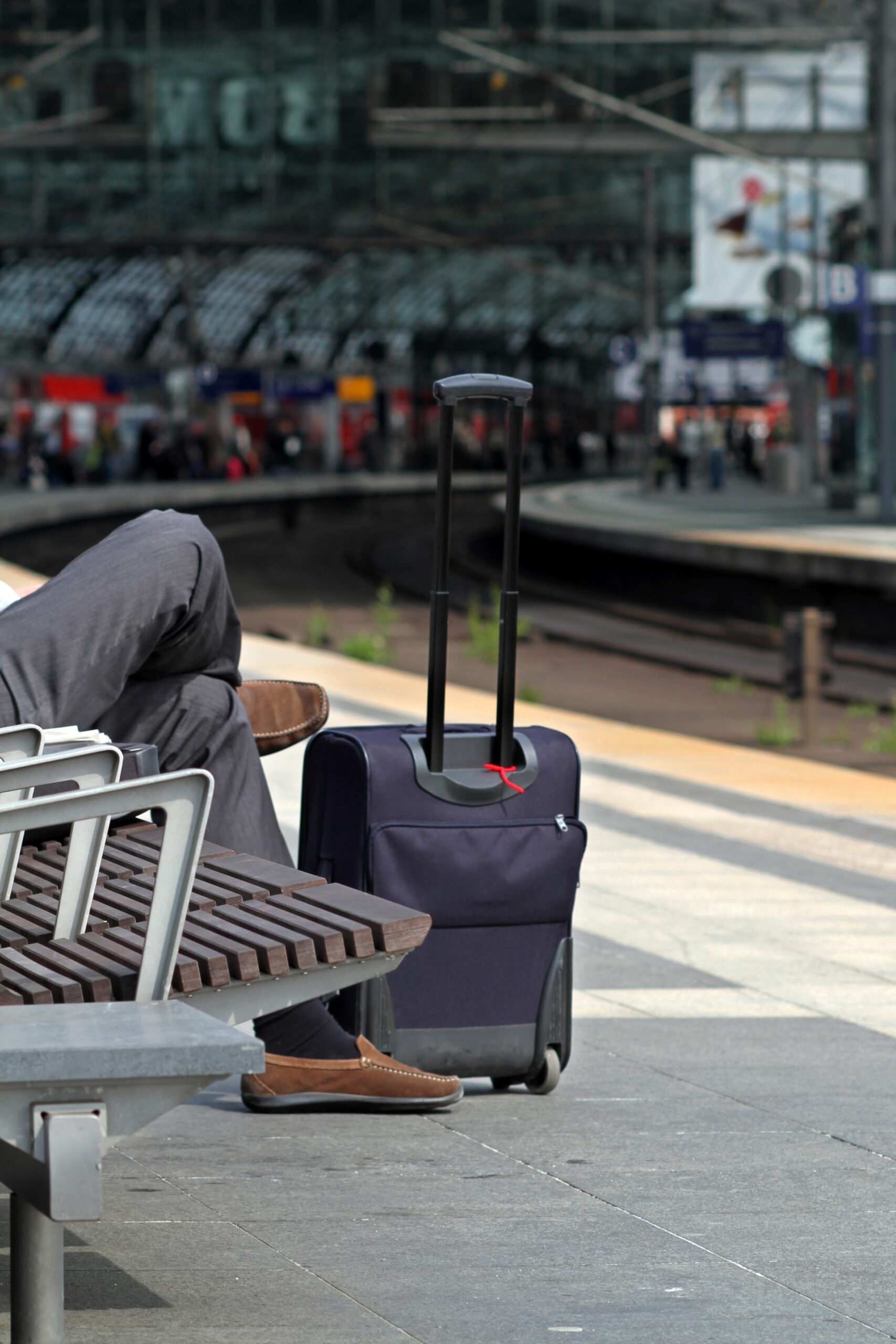
 Bild: Mostphotos
Passengers have high expectations on public transport punctuality
Passengers on public transport have high expectations that buses and trains will run on time, but if the journey is safe and comfortable, there is a greater tolerance for delays. However, public transport authorities seem to overestimate passengers’ tolerance for lack of punctuality.
There are several different ways to measure punctuality in public transport, including timetable adherence and passengers’ more subjective perception of punctuality. K2-researchers Carl-William Palmqvist and Ulrik Berggren from Lund University and Roger Pyddoke from the Swedish National Road and Transport Research Institute (VTI) have studied how objective and more subjectively perceived punctuality relate, to what extent passengers’ perceptions correspond to actual delays.
“Our studies show that passengers’ experiences are largely influenced by other factors, such as safety and comfort. If it is quiet and clean, moderately warm and passengers have comfortable seats, their tolerance for delays are higher and minor delays are not perceived as being as inconvenient”, says Carl-William Palmqvist.
In Swedish national statistics on train punctuality, a train is considered delayed if it arrives more than five minutes after the scheduled time.
“Public transport providers generally seem to overestimate passengers’ tolerance for delays. Those who travel by train consider a train to be late if it arrives one minute after the timetable, and public transport passengers have high expectations on punctuality”, Carl-William continues.
Buses may depart ahead of schedule
There are no corresponding national statistics on punctuality for bus services, but regional public transport authorities collect data on punctuality, which is used, among other things, as a basis for compensation to contracted bus service providers.
“Those who travel by bus seem to have a slightly greater tolerance for delays than those who travel by train. However, they do not accept that the bus sometimes depart before the time stated in the timetable, this is perceived very negatively”, says Ulrik Berggren.
Bus timetables often state that the bus may depart up to three minutes before or after the time specified in the timetable. Passengers therefore need a three-minute margin to be sure they can travel on the bus they have planned.
Survey studies can serve as an overall quality measurement
According to the researchers, a relatively large discrepancy between actual and perceived punctuality indicates that it is difficult to use subjective measurements to evaluate individual routes.
“Especially those who travel by bus seem to respond more generally to how they perceive comfort and punctuality, even if the question concerns punctuality on a specific journey or route. The results of subjective survey studies should therefore be interpreted as an overall quality measurement, rather than a tool for evaluating, for example, a changed bus route”, says Ulrik.
“In order to meet passengers’ expectations of punctuality, public transport authorities need to have a higher level of ambition than today”, Carl-William Palmqvist concludes.
You can read more about the correlation between actual and perceived punctuality in the article:
Read about the study in the article in Case Studies on Transport Policy:
Measured service reliability and customer satisfaction in public transport – sciencedirect.com
Text: Hanna Holm
More recent research on train delays
The punctuality of Swedish trains is a frequently debated issue. Here are several recent studies involving K2 researchers, each focusing on different aspects of delays.
Primary delays must be halved
In this study, researchers examined why trains are delayed and what is required to achieve the target of 95% punctuality. Using computer simulations, they analysed rail traffic in the metropolitan regions of Stockholm, Gothenburg and Malmö. The findings show that most delays originate as so-called primary delays, for example at stations or when trains are introduced into service, and that these then propagate to other services. The way this occurs differs markedly between regions. In Stockholm and Malmö, station-related delays dominate, whereas Gothenburg shows a more even distribution across different delay types. The study concludes that primary delays need to be reduced by around half in order to meet the punctuality target. It also emphasises that measures must be tailored regionally and that reducing station delays is critical for improving punctuality.
Simulating railway punctuality in three Swedish metropolitan regions – lu.se
The need for dwell time margins is underestimated
Station dwell times account for a significant share of total journey time in rail operations and are an important source of delays. Despite this, the time margins built into dwell times have been studied far less than equivalent margins for running times. In this study, the researchers introduce the concept of “tight dwell time” – the minimum time required for alighting and boarding, including technical processes, but excluding any buffer. The results indicate that established rules of thumb often underestimate the need for margins. Two new methods are presented that provide more accurate estimates and can be used to better design future timetables, improving both robustness and capacity utilisation.
Boarding and alighting take longer than theoretical studies suggest
The speed at which passengers can alight from and board trains is crucial in determining dwell times and, consequently, punctuality in commuter rail services. However, much of the current understanding of passenger flows is based on theoretical studies that may differ from real-world conditions. In this study, researchers analysed more than a thousand boarding and alighting events at Lund Central Station using drone footage. The results show that the rate of alighting increases as more passengers alight, but only up to a certain level. Boarding rates, by contrast, are less affected by volume and more by other factors. Luggage slows both alighting and boarding, while bicycles primarily affect boarding. The study also shows that flows in real environments are slower than many theoretical studies suggest.
A naturalistic study into the flow of alighting and boarding passengers of commuter trains
Can platform interventions influence passenger behaviour?
This study investigates whether simple platform interventions can influence passenger behaviour and reduce the risk of delays during station stops. The researchers examined a sticker-based platform intervention at Lund Central Station, aimed at encouraging boarding passengers to spread out more evenly and facilitate alighting. Boarding and alighting were analysed using drone footage. The results show a slight increase in alighting speed with the markings, but no statistically significant improvement in how boarding passengers distributed themselves between doors. The effects were also limited to a certain range of passenger volumes.
How much later trains run due to switch failures
Switches and crossings are often identified as a major source of unreliability in the railway, but how much do they actually delay individual trains? In this study, researchers combined five years of operations and maintenance data (2016–2020) and compared days with active switch failures to days without. They estimated both the “excess risk” of delay and the additional delay time. The results show that, in the event of a switch failure, the probability of a dwell-time delay increases by about one percentage point, while maintenance warnings have a negligible effect. When a switch failure occurs, trains are delayed by an average of six minutes. The researchers highlight that this knowledge is relevant for operational prioritisation and for more realistic simulation of primary delays.
The Impact of Switch Faults on Train Delays: A Case Study of the Swedish Railway Network
Differences in how delays propagate along a line
Delays often propagate along a railway line, but their impact is not uniform. In this study, researchers examined what actually drives real-time arrival delays for high-speed trains, and whether the same factors are equally influential at all stations. Using operational data from the Southern Main Line, they analysed how delays, running times and dwell times at previous stations affect the next arrival. The results show that the delay at the immediately preceding station and the dwell time there are the most important factors, but their influence varies along the line. The study highlights the need for station-specific real-time control rather than a single general forecasting model, both for traffic management and for providing more reliable passenger information.
Real-time High-Speed Train Delay Prediction using Seemingly Unrelated Regression Models
Which models for train delays are most fit for purpose?
An increasing number of data-driven models are used to predict train delays in real time, but there is currently a lack of common guidelines for evaluating such models. In this study, researchers reviewed 67 scientific articles on data-driven delay prediction for trains and analysed how the models are actually evaluated. Based on this review, they present the AP-GRIP framework, which proposes that models should be assessed across six dimensions: accuracy, precision, generalisability, robustness, interpretability and practical applicability. The framework shows when, where and for whom different models perform well, and when they risk failing.