
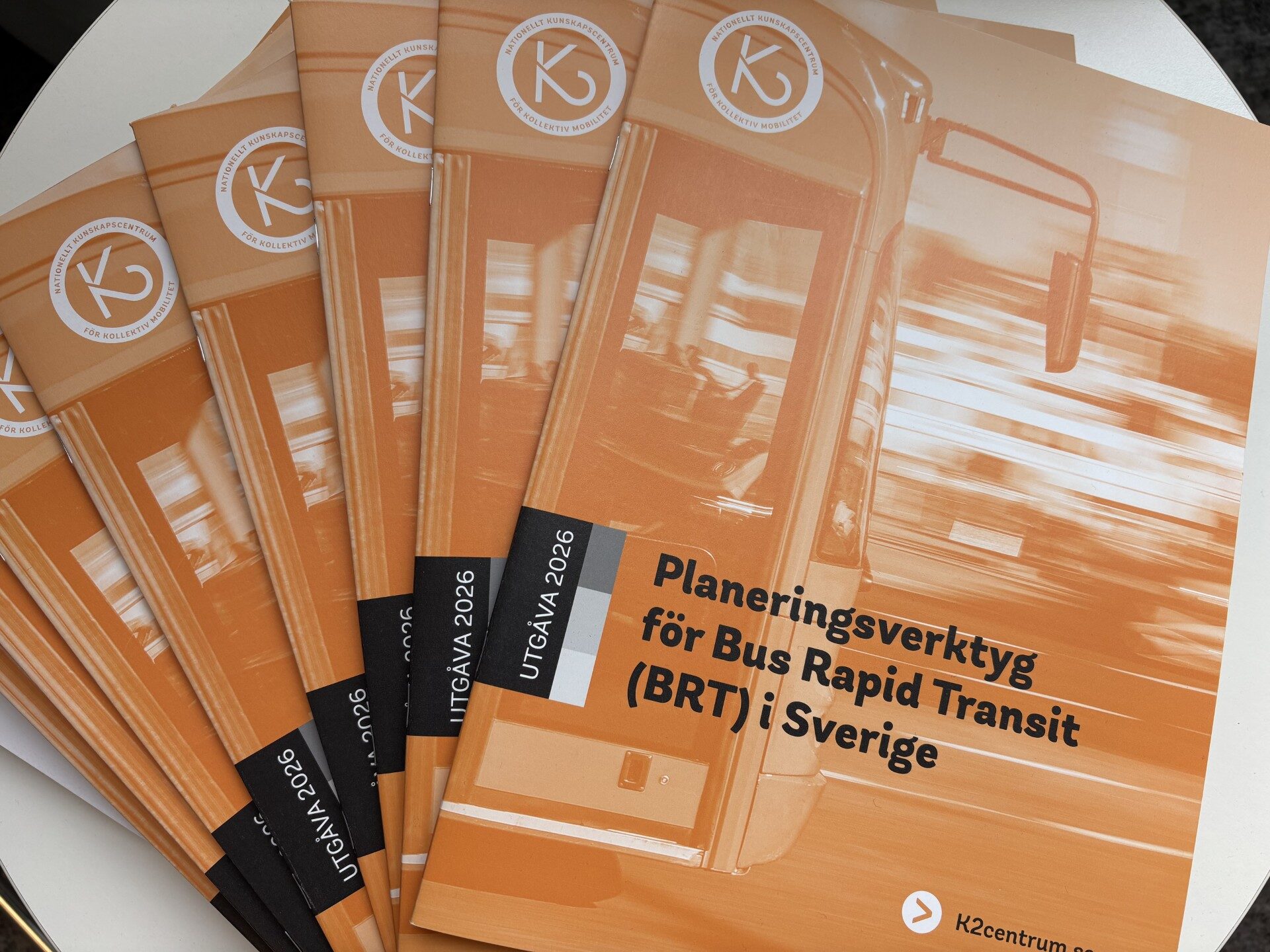
An updated BRT Tool launched – and now also in English
An updated version of K2’s BRT tool is now available for those working with planning or implementing BRT. The update mainly consists of clarifications of the parameters in the tool’s scorecard, with examples and more detailed descriptions. The tool has also been given a more accessible format and is also published in English this time.
The latest version of the BRT tool was launched in 2024 by researchers Joel Hansson, Jakob Allansson and Fredrik Pettersson-Löfstedt. It was developed to create a common frame of reference for what high-quality bus services entail in a Swedish context. Since then, several new studies relevant to the planning tool have been carried out. The tool has also been tested in more contexts, generating valuable feedback and suggestions for improvement.
“The aim of the update is to make the tool clearer and more user-friendly, including through clarified parameters, more detailed descriptions and more examples with images from different cities in Sweden and the rest of Europe,” says Joel Hansson.
At the same time, Joel Hansson emphasises that the researchers have sought to make as few changes as possible to the scoring itself in order to maintain comparability with previous assessments.
“We have analysed this and found that scoring with the updated tool in most cases differs by only a few points compared with the previous version. Some minor adjustments have, however, also been made to the scorecard itself in order to simplify its use,” he says.
In connection with the update, the tool has also been given a more appealing design.
To improve quality and facilitate early planning
The background to the BRT tool is the need to improve the quality of bus services in Swedish cities. The concept of BRT has been used in many different ways, leading to unclear expectations when ideas for high-quality bus systems are to be realised. The tool is intended to help municipalities, regions and other stakeholders to discuss levels of ambition, prioritise the right measures and ensure that different parts of the system— infrastructure, operations, vehicles and urban design—are aligned.
“The hope is that the tool will function as support for a shared dialogue, rather than as a definitive answer. It can be used especially in the early stages of planning to set goals and levels of ambition, and as support when designing corridors and making trade-offs in street space,” says Joel Hansson.
He also points out that the tool makes it easier to see the whole picture—that high quality is not created by a single measure.
Also launched in English
The Swedish BRT tool has been developed to function in Swedish and Nordic conditions. The researchers have, however, noted an interest in this approach elsewhere in Europe. Internationally, The BRT Standard has been an important source of inspiration for BRT planning, but it is primarily adapted for very large cities and corridors with extremely high capacity demands. The researchers have therefore chosen to publish the new version of the planning tool in English as well.
“At present, we see growing interest in BRT and BRT-like solutions both in Sweden and across Europe, as a tool to strengthen the identity and function of cities. BRT is, however, a broad concept with different components that can be applied to varying degrees – each project is unique – which the planning tool takes into account by allowing a certain score level to be achieved in many different ways,” says Joel Hansson.
The planning tool has been developed for free use by municipalities, regions, consultants and other stakeholders and may be freely shared. The ambition is for it to function as a shared knowledge base in planning processes.
“Of course, you are also welcome to get in touch with questions, comments or experiences from using the tool—feedback is important for its continued development,” says Joel Hansson.
Link to the tool:
Planning tool for Bus Rapid Transit (BRT) in Sweden, edition 2026 – K2
Text: Anna Maria Erling